 Official websites use .gov
A .gov website belongs to an official government organization in the United States.
 Secure .gov websites use HTTPS
A lock (Lock A locked padlock) or https:// means you’ve safely connected to the .gov website. Share sensitive information only on official, secure websites.
Airport Deicing Effluent Guidelines
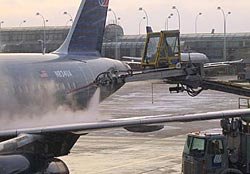 The EPA promulgated the Airport Deicing Effluent Guidelines in 2012 (40 CFR Part 449Exit EPA’s website). The requirements generally apply to wastewater associated with the deicing of airfield pavement at commercial airports. The rule also established New Source Performance Standards for wastewater discharges associated with aircraft deicing for a subset of new airports. These requirements are incorporated into NPDES permits.
On this page:
* Background
* Facilities Covered
* Related Information
* Additional Information
The EPA promulgated the Airport Deicing Effluent Guidelines in 2012 (40 CFR Part 449Exit EPA’s website). The requirements generally apply to wastewater associated with the deicing of airfield pavement at commercial airports. The rule also established New Source Performance Standards for wastewater discharges associated with aircraft deicing for a subset of new airports. These requirements are incorporated into NPDES permits.
On this page:
* Background
* Facilities Covered
* Related Information
* Additional Information
Background
The Federal Aviation AdministrationExit EPA’s website (FAA) requires airlines and airports that operate during icy conditions to perform deicing and anti-icing of aircraft and airfield pavement. This ensures the safety of passengers and cargo operations. However, when performed without discharge controls in place, these deicing operations can degrade nearby water bodies. Airports are required to obtain stormwater discharge permits under the NPDES program and ensure that wastes from deicing operations are properly collected and treated.
Facilities Covered
The Effluent Guidelines require existing and new primary airportsprimary airportsA primary airport is a commercial service airport with more than 10,000 passenger boardings each year (49 U.S.C. 47102). with 1,000 or more annual jet departures that discharge wastewater associated with airfield pavement deicing to use non-urea-containing deicers, or alternatively, meet a numeric effluent limitation for ammonia.
New airports with 10,000 annual departures located in certain cold climate zones are required to collect 60 percent of aircraft deicing fluid after deicing. Airports that discharge the collected aircraft deicing fluid directly to waters of the U.S. must also meet numeric discharge requirements for chemical oxygen demand.
The Effluent Guidelines do not establish requirements for aircraft deicing discharges at existing airports. Such requirements will continue to be established in general permitsgeneral permitsAn NPDES general permit is written to cover multiple dischargers with similar operations and types of discharges., or for individual permits on a site-specific basis.
* Final Rule - Federal Register NoticeExit EPA’s website (May 16, 2012)
* Support documents, including:
* Fact Sheet
* Technical Development Document
Industry description, wastewater characterization, treatment technologies, pollution prevention techniques, regulatory compliance cost estimates and pollutant loadings for the final rule
* Economic Analysis
Analysis of the costs and economic impacts of the final rule
* Environmental Impact and Benefit Assessment
Evaluates environmental concerns and potential exposures (wildlife and humans) to pollutants commonly found in industry wastewater discharges and estimates the environmental improvements associated with the final rule
Documents related to this rulemaking can be found at EPA’s on-line docket website at regulations.govExit EPA’s website. The docket number is EPA-HQ-OW-2004-0038. * Users Guide to the Airport Deicing Docket - includes Record Index * (176.11 KB, July 2012)
Related Information
- NPDES Industrial Stormwater Program
- Industrial Stormwater Fact Sheet:
Sector S: Vehicle Maintenance Areas, Equipment Cleaning Areas, or Deicing Areas Located at Air Transportation Facilities (2021)
- Industrial Stormwater Fact Sheet:
- EPA Multi-Sector General Permit (2021)
- FAA Advisory Circulars for Airport ProjectsExit EPA’s website
Background Documents
- Airport Deicing Proposed Rule - Federal Register NoticeExit EPA’s website (August 28, 2009)
- Preliminary Data Summary: Airport Deicing Operations (August 2000)
Information on the industry's wastewater characteristics, treatment systems and management practices, environmental impacts, compliance costs and economic conditions in the industry in the late 1990s
Additional Information
For additional information, please contact Doruntinë Rexhepi (rexhepi.doruntine@epa.gov) or 202-566-2532.
Effluent Guidelines
Open Sidenav Menu Close Sidenav Menu Contact Us About Effluent Guidelines Contact Us About Effluent Guidelines to ask a question, provide feedback, or report a problem. Last updated on March 24, 2026 Welcome! Please share your feedback on how we can make www.epa.gov work better for you. A red asterisk (*) indicates a required field.
Success
Thank you. Your feedback has been received.
Error
alert message Required Questions - page 1 of 2 question_55203_answer_01 How would you rate your experience on www.epa.gov today? *
0 Stars 1 Star 2 Stars 3 Stars 4 Stars 5 Stars Please explain the reason for your rating. * 400 characters allowed Would you like to take two more minutes to answer more questions to help us improve our services? Yes, keep going → No, only submit these responses Optional questions - page 2 of 2 How would you describe yourself? Business Government employee Scientist Student Other Enter other text Please tell us why you visited www.epa.gov today. 400 characters allowed Did you visit www.epa.gov to accomplish a specific task? If yes, please explain why you were able or unable to accomplish your task. 400 characters allowed How can we make www.epa.gov a more helpful website? 400 characters allowed Submit [NPDES]: National Pollutant Discharge Elimination System [*]: required