 Official websites use .gov
A .gov website belongs to an official government organization in the United States.
 Secure .gov websites use HTTPS
A lock (Lock A locked padlock) or https:// means you’ve safely connected to the .gov website. Share sensitive information only on official, secure websites.
Dairy Products Processing Effluent Guidelines
 The EPA promulgated the Dairy Products Processing Effluent Guidelines and Standards (40 CFR Part 405Exit EPA’s website) in 1974 and 1975. The regulation covers directdirectA point source that discharges pollutants to waters of the United States, such as streams, lakes, or oceans. and indirectindirectA facility that discharges pollutants to a publicly owned treatment works (municipal sewage treatment plant). dischargers. The Effluent Guidelines and Standards are incorporated into NPDES permits for direct dischargers, and permits or other control mechanisms for indirect dischargers (see Pretreatment Program).
On this page:
* What is the Dairy Products Processing Industry?
* Wastestreams, Pollutants, and Subcategories
* Rulemaking History
* Additional Information
The EPA promulgated the Dairy Products Processing Effluent Guidelines and Standards (40 CFR Part 405Exit EPA’s website) in 1974 and 1975. The regulation covers directdirectA point source that discharges pollutants to waters of the United States, such as streams, lakes, or oceans. and indirectindirectA facility that discharges pollutants to a publicly owned treatment works (municipal sewage treatment plant). dischargers. The Effluent Guidelines and Standards are incorporated into NPDES permits for direct dischargers, and permits or other control mechanisms for indirect dischargers (see Pretreatment Program).
On this page:
* What is the Dairy Products Processing Industry?
* Wastestreams, Pollutants, and Subcategories
* Rulemaking History
* Additional Information
What is the Dairy Products Processing Industry?
Related Information * Stormwater fact sheet (Sector U: Food and Kindred Products Facilities)
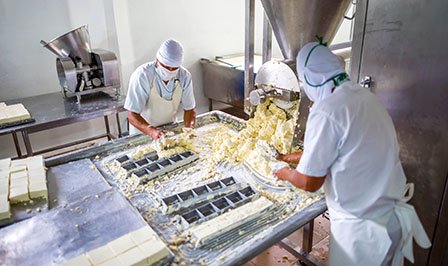
Dairy products are manufactured with milk or milk by-products, including whey and buttermilk, as the sole or principal raw material. Typical products include fluid milk, butter, cheese (natural and processed), ice cream and other frozen products, and yogurt. Dairy products are included within NAICS group 3115. The NAICS listing is provided as a guide and does not define the coverage of the Dairy Products Processing category. For precise definitions of coverage, see the applicability sections in 40 CFR Part 405Exit EPA’s website.
Wastestreams, Pollutants, and Subcategories
Wastestreams
The industry’s principal wastestreams are: * Cleaning out of product remaining in tank trucks, cans, piping, tanks, and other equipment * Spillage produced by leaks, overflow, freezing-on, boiling-over, equipment malfunction or operator error * Processing losses, including sludge discharges from clarifiers and product wasted during pasteurizer start-up, shut-down, and product change-over * Wastage of spoiled products, returned products, or byproducts * Detergents and other cleaning compounds.
Regulated Pollutants
- BOD5
- TSS
- pH (abnormally high or low)
Regulation Subcategories
- Receiving Stations (Subpart AExit EPA’s website)
- Fluid Products (Subpart BExit EPA’s website)
- Cultured Products (Subpart CExit EPA’s website)
- Butter (Subpart DExit EPA’s website)
- Cottage Cheese and Cultured Cream Cheese (Subpart EExit EPA’s website)
- Natural and Processed Cheese (Subpart FExit EPA’s website)
- Fluid Mix for Ice Cream and Other Frozen Desserts (Subpart GExit EPA’s website)
- Ice Cream, Frozen Desserts, Novelties and Other Dairy Desserts (Subpart HExit EPA’s website)
- Condensed Milk (Subpart IExit EPA’s website)
- Dry Milk (Subpart JExit EPA’s website)
- Condensed Whey (Subpart KExit EPA’s website)
- Dry Whey (Subpart LExit EPA’s website)
Rulemaking History
1975 Amendment
PSES * Documents, including: * Final Rule (February 11, 1975) * Proposed Rule (May 28, 1974)
1974 Initial Rulemaking
BPT, BAT, NSPS, PSNS
* Documents, including:
* Final Rule (May 28, 1974)
* Development Document (May 1974)
Industry description, wastewater characterization, treatment technologies, regulatory compliance cost estimates and pollutant loadings for the final rule
* Proposed Rule (December 20, 1973)
Additional Information
For additional information regarding the Dairy Products Processing Effluent Guidelines, please contact Meghan Hessenauer (hessenauer.meghan@epa.gov) or 202-566-1040.
Effluent Guidelines
Open Sidenav Menu Close Sidenav Menu Contact Us About Effluent Guidelines Contact Us About Effluent Guidelines to ask a question, provide feedback, or report a problem. Last updated on May 8, 2026 Welcome! Please share your feedback on how we can make www.epa.gov work better for you. A red asterisk (*) indicates a required field.
Success
Thank you. Your feedback has been received.
Error
alert message Required Questions - page 1 of 2 question_55203_answer_01 How would you rate your experience on www.epa.gov today? *
0 Stars 1 Star 2 Stars 3 Stars 4 Stars 5 Stars Please explain the reason for your rating. * 400 characters allowed Would you like to take two more minutes to answer more questions to help us improve our services? Yes, keep going → No, only submit these responses Optional questions - page 2 of 2 How would you describe yourself? Business Government employee Scientist Student Other Enter other text Please tell us why you visited www.epa.gov today. 400 characters allowed Did you visit www.epa.gov to accomplish a specific task? If yes, please explain why you were able or unable to accomplish your task. 400 characters allowed How can we make www.epa.gov a more helpful website? 400 characters allowed Submit [NPDES]: National Pollutant Discharge Elimination System [NAICS]: North American Industrial Classification System [BOD5]: biochemical oxygen demand [TSS]: total suspended solids [PSES]: Pretreatment Standards for Existing Sources [BPT]: Best Practicable Pollutant Control Technology Currently Available [BAT]: Best Available Technology Economically Achievable [NSPS]: New Source Performance Standards [PSNS]: Pretreatment Standards for New Sources [*]: required