 Official websites use .gov
A .gov website belongs to an official government organization in the United States.
 Secure .gov websites use HTTPS
A lock (Lock A locked padlock) or https:// means you’ve safely connected to the .gov website. Share sensitive information only on official, secure websites.
Explosives Manufacturing Effluent Guidelines
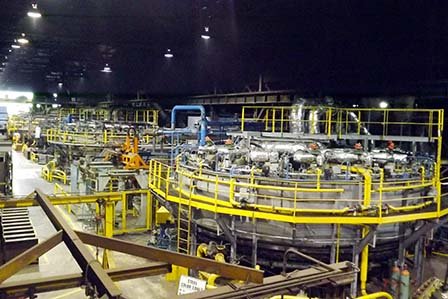 The EPA promulgated the Explosives Manufacturing Effluent Guidelines (40 CFR Part 457Exit EPA’s website) in 1976. The regulation only applies to direct dischargersdirect dischargersA point source that discharges pollutants to waters of the United States, such as streams, lakes, or oceans.. The Effluent Guidelines are incorporated into NPDES permits.
On this page:
* What is the Explosives Manufacturing Industry?
* Pollutants and Subcategories
* Rulemaking History
* Additional Information
The EPA promulgated the Explosives Manufacturing Effluent Guidelines (40 CFR Part 457Exit EPA’s website) in 1976. The regulation only applies to direct dischargersdirect dischargersA point source that discharges pollutants to waters of the United States, such as streams, lakes, or oceans.. The Effluent Guidelines are incorporated into NPDES permits.
On this page:
* What is the Explosives Manufacturing Industry?
* Pollutants and Subcategories
* Rulemaking History
* Additional Information
What is the Explosives Manufacturing Industry?
Explosives manufacturing can be divided into two broad areas: military and commercial. Military plants produce strictly for the military and commercial plants produce for both military and non-military clients. Plants can differ in size, product, and type of operation. Ammonium nitrate-based explosives, dynamite, and nitroglycerin are generally considered commercial explosives, while TNT, HMX, and RDX are generally considered military explosives. Sources of wastewater pollutants include aqueous wastes from reactors, filtration systems, decanting systems, distillation vacuum exhaust scrubbers, caustic scrubbers, process equipment cleanouts, area washdowns, formulation equipment cleanup, and spill washdowns. Explosives Manufacturing is included within NAICS group 325920. The NAICS listing is provided as a guide and does not define the coverage of the Explosives Manufacturing category. For precise definitions of coverage, see the applicability sections in 40 CFR Part 457Exit EPA’s website.
Pollutants and Subcategories
Regulated Pollutants
The regulated parameters vary by subcategory, and include the following: * COD * BOD5 * TSS * pH (abnormally high or low) * Oil and grease
Regulation Subcategories
- Manufacture of Explosives (Subpart AExit EPA’s website)
- Explosives Load, Assemble, and Pack Plants (plants which blend explosives and market a final product, and plants that fill shells and blasting caps) (Subpart CExit EPA’s website)
Subpart B is currently reserved.
Excluded Processes
In explosives manufacturing, a portion of the wastewater pollutants comes from the manufacture, concentration, recovery, and purification of sulfuric, nitric, acetic, and other acids. The wastes associated with this portion of explosives manufacturing are addressed in other Effluent Guidelines categories: * Organic Chemicals, Plastics and Synthetic Fibers (OCPSF) (40 CFR Part 414Exit EPA’s website) * Inorganic Chemicals Manufacturing (40 CFR Part 415Exit EPA’s website) * Fertilizer Manufacturing (40 CFR Part 418Exit EPA’s website)
Rulemaking History
1976 Initial Rulemaking
BPT
* Documents, including:
* Interim Final Rule (March 9, 1976)
* Development Document (March 1976)
Industry description, wastewater characterization, treatment technologies, regulatory compliance cost estimates and pollutant loadings for the final rule
Additional Information
For additional information regarding the Explosives Manufacturing Effluent Guidelines, please contact Anthony Tripp (tripp.anthony@epa.gov) or 202-566-1419.
Effluent Guidelines
Open Sidenav Menu Close Sidenav Menu Contact Us About Effluent Guidelines Contact Us About Effluent Guidelines to ask a question, provide feedback, or report a problem. Last updated on June 3, 2025 Welcome! Please share your feedback on how we can make www.epa.gov work better for you. A red asterisk (*) indicates a required field.
Success
Thank you. Your feedback has been received.
Error
alert message Required Questions - page 1 of 2 question_55203_answer_01 How would you rate your experience on www.epa.gov today? *
0 Stars 1 Star 2 Stars 3 Stars 4 Stars 5 Stars Please explain the reason for your rating. * 400 characters allowed Would you like to take two more minutes to answer more questions to help us improve our services? Yes, keep going → No, only submit these responses Optional questions - page 2 of 2 How would you describe yourself? Business Government employee Scientist Student Other Enter other text Please tell us why you visited www.epa.gov today. 400 characters allowed Did you visit www.epa.gov to accomplish a specific task? If yes, please explain why you were able or unable to accomplish your task. 400 characters allowed How can we make www.epa.gov a more helpful website? 400 characters allowed Submit [TNT]: trinitrotoluene [HMX]: cyclotetramethylene tetranitramine [RDX]: cyclotrimethylene trinitramine [NAICS]: North American Industrial Classification System [COD]: chemical oxygen demand [BOD5]: biochemical oxygen demand [TSS]: total suspended solids [BPT]: Best Practicable Pollutant Control Technology Currently Available []: required