 Official websites use .gov
A .gov website belongs to an official government organization in the United States.
 Secure .gov websites use HTTPS
A lock (Lock A locked padlock) or https:// means you’ve safely connected to the .gov website. Share sensitive information only on official, secure websites.
Metal Finishing Effluent Guidelines
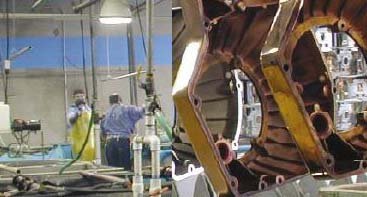 The EPA promulgated the Metal Finishing Effluent Guidelines (40 CFR Part 433Exit EPA’s website) in 1983, with technical amendments in 1984 and 1986. The regulations cover wastewater discharges from a wide variety of industries performing various metal finishing operations. About 44,000 facilities perform various metal finishing operations and discharge process wastewater directly to surface waters or indirectly to surface waters through POTWs. The Metal Finishing Effluent Guidelines are incorporated into NPDES permits for direct dischargers, and permits or other control mechanisms for indirect dischargers (refer to Pretreatment Program).
On this page:
* What is Metal Finishing?
* Current Rulemaking for Chrome Finishing Facilities
* Existing Rule - Facilities Covered
* Core Operations
* Related Categories
* Guidance and Background Documents
* Rulemaking History
* Additional Information
The EPA promulgated the Metal Finishing Effluent Guidelines (40 CFR Part 433Exit EPA’s website) in 1983, with technical amendments in 1984 and 1986. The regulations cover wastewater discharges from a wide variety of industries performing various metal finishing operations. About 44,000 facilities perform various metal finishing operations and discharge process wastewater directly to surface waters or indirectly to surface waters through POTWs. The Metal Finishing Effluent Guidelines are incorporated into NPDES permits for direct dischargers, and permits or other control mechanisms for indirect dischargers (refer to Pretreatment Program).
On this page:
* What is Metal Finishing?
* Current Rulemaking for Chrome Finishing Facilities
* Existing Rule - Facilities Covered
* Core Operations
* Related Categories
* Guidance and Background Documents
* Rulemaking History
* Additional Information
What is Metal Finishing?
Metal finishing is the process of changing the surface of an object, for the purpose of improving its appearance and/or durability. Metal finishing is related to electroplating, which is the production of a thin surface coating of the metal upon another by electrodeposition.
Current Rulemaking for Chrome Finishing Facilities
Following announcement in the Preliminary Effluent Guidelines Program Plan 15 (September 2021), the EPA is conducting a rulemaking to address per- and polyfluoroalkyl substances (PFAS) discharges from a subset of facilities in the Metal Finishing and Electroplating point source categories. Based on information and data collected during the Multi-Industry PFAS Study, the EPA determined PFAS are used by some metal finishing and electroplating facilities to control hexavalent chromium emissions, a known human carcinogen and inhalation hazard. The EPA determined facilities performing certain chromium operations, hereafter referred to as “chrome finishing facilities,” including chromium plating, chromium anodizing, chromic acid etching, and chromate conversion coating operations, are the predominant sources of PFAS discharges by the Metal Finishing and Electroplating point source categories. All supporting materials for the rulemaking can be found at the EPA's docket at regulations.govExit EPA’s website. The Docket Number is EPA-HQ-OW-2022-0869.
Existing Rule - Facilities Covered
Related Information * Stormwater fact sheets (Sectors AA, AB, AC)
The Metal Finishing regulation is defined by manufacturing processes and not by industrial sectors. However, facilities regulated by the Metal Finishing Effluent Guidelines are often included in the SIC Major Groups 34 through 39: 1. Fabricated Metal Products, except Machinery and Transportation 2. Machinery, except Electrical 3. Electrical and Electronic Machinery, Equipment and Supplies 4. Transportation Equipment 5. Measuring, Analyzing and Controlling Instruments: Photograph; Optical Goods; Watches and Clocks 6. Miscellaneous Manufacturing Industries
Core Operations
The category covers plants which perform one or more of the following six operations: * electroplating (exceptions: refer to Related Categories) * electroless plating * anodizing * coating (phosphating, chromating, and coloring) * chemical etching and milling * printed circuit board manufacture (exceptions: refer to Related Categories)
If a plant performs any of those six operations, then discharges from the 46 operations listed in 40 CFR 433.10(a)Exit EPA’s website are covered by the Part 433 standards.
Related Categories
Certain electroplating processes are covered by the Electroplating Category, 40 CFR Part 413Exit EPA’s website, rather than Metal Finishing: * "job shop" electroplaters (those which in a calendar year do not own more than 50 percent of the material undergoing metal finishing), and * independent printed circuit board manufacturers, * which are located at indirect discharger facilities, and * that were in operation before July 15, 1983.
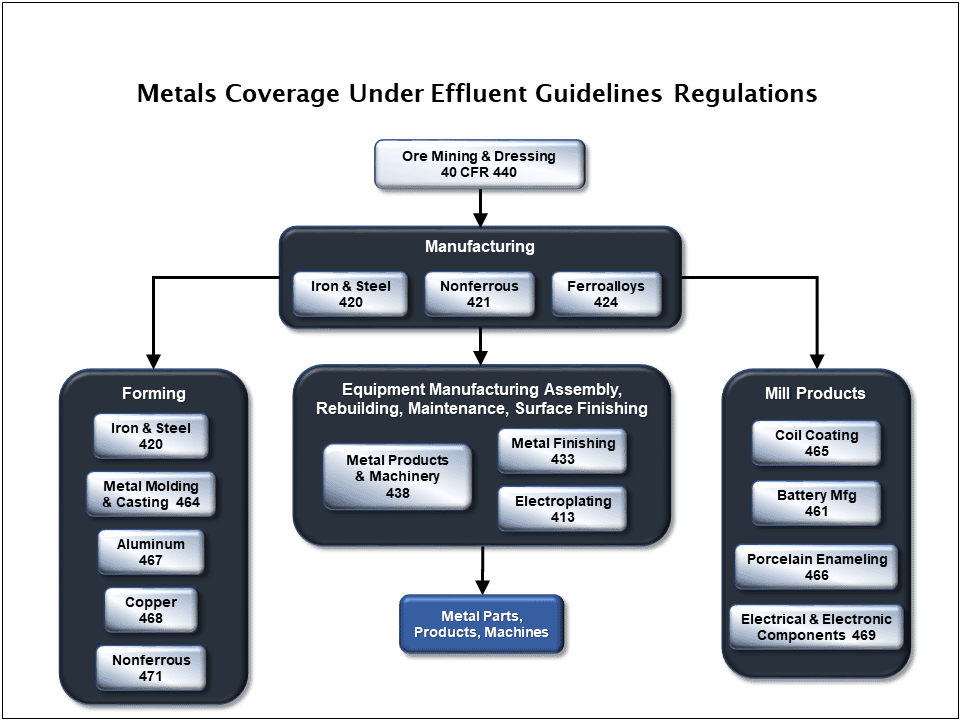 Metals coverage under Effluent Guidelines
- Click to enlarge
In addition to the job shop electroplaters, discharges from the 46 metal finishing operations may be more properly and effectively regulated by the following categories:
* Aluminum Forming (40 CFR Part 467Exit EPA’s website)
* Battery Manufacturing (40 CFR Part 461Exit EPA’s website)
* Coil Coating (40 CFR Part 465Exit EPA’s website)
* Copper Forming (40 CFR Part 468Exit EPA’s website)
* Electrical and Electronic Components (40 CFR Part 469Exit EPA’s website)
* Iron and Steel Manufacturing (40 CFR Part 420Exit EPA’s website)
* Metal Molding and Casting (Foundries) (40 CFR Part 464Exit EPA’s website)
* Nonferrous Metals Forming and Metal Powders (40 CFR Part 471Exit EPA’s website)
* Nonferrous Metals Manufacturing (40 CFR Part 421Exit EPA’s website)
* Plastics Molding and Forming (40 CFR Part 463Exit EPA’s website)
* Porcelain Enameling (40 CFR Part 466Exit EPA’s website)
Guidance and Background Documents
- Download the publications
- Coverage for Zirconization™ process (Memo, April 2016)
- "Chemical Etching" Metal Finishing Option (Memo, June 2004)
- Regulatory Determination for the "PreKote" Surface Preparation Process (April 2003)
- Misuse of Sodium Dimethyldithiocarbamate (Memo, June 2000)
- Permitting Guidance for Semiconductor Manufacturing Facilities (Memo, April 1998)
- Guidance Manual for Implementing Total Toxic Organics (TTO) Pretreatment Standards (1985)
- Guidance Manual for Electroplating and Metal Finishing Pretreatment Standards (1984)
Rulemaking History
- Download the publications
- Technical Amendment (November 7, 1986)
- Correction (October 3, 1983)
- Interpretation and Correction (September 26, 1983)
- Technical Amendment (September 15, 1983)
- Final Rule: Metal Finishing and Electroplating Categories (July 15, 1983)
- Development Document (1983)
Industry description, wastewater characterization, treatment technologies, regulatory compliance cost estimates and pollutant loadings for the final rule - Proposed Rule: Metal Finishing and Electroplating Categories (August 31, 1982)
Additional Information
For additional information regarding the current rulemaking to regulate the discharge of PFAS from chrome finishing facilities only , please contact Phillip Flanders (flanders.phillip@epa.gov) or 202-566-8323. For all other questions about the Metal Finishing Effluent Guidelines, please contact Ahmar Siddiqui (siddiqui.ahmar@epa.gov) or 202-566-1044.
Effluent Guidelines
Open Sidenav Menu Close Sidenav Menu Contact Us About Effluent Guidelines Contact Us About Effluent Guidelines to ask a question, provide feedback, or report a problem. Last updated on March 17, 2026 Welcome! Please share your feedback on how we can make www.epa.gov work better for you. A red asterisk (*) indicates a required field.
Success
Thank you. Your feedback has been received.
Error
alert message Required Questions - page 1 of 2 question_55203_answer_01 How would you rate your experience on www.epa.gov today? *
0 Stars 1 Star 2 Stars 3 Stars 4 Stars 5 Stars Please explain the reason for your rating. * 400 characters allowed Would you like to take two more minutes to answer more questions to help us improve our services? Yes, keep going → No, only submit these responses Optional questions - page 2 of 2 How would you describe yourself? Business Government employee Scientist Student Other Enter other text Please tell us why you visited www.epa.gov today. 400 characters allowed Did you visit www.epa.gov to accomplish a specific task? If yes, please explain why you were able or unable to accomplish your task. 400 characters allowed How can we make www.epa.gov a more helpful website? 400 characters allowed Submit [POTWs]: publicly owned treatment works [NPDES]: National Pollutant Discharge Elimination System [SIC]: Standard Industrial Classification [*]: required