 Official websites use .gov
A .gov website belongs to an official government organization in the United States.
 Secure .gov websites use HTTPS
A lock (Lock A locked padlock) or https:// means you’ve safely connected to the .gov website. Share sensitive information only on official, secure websites.
Nonferrous Metals Manufacturing Effluent Guidelines
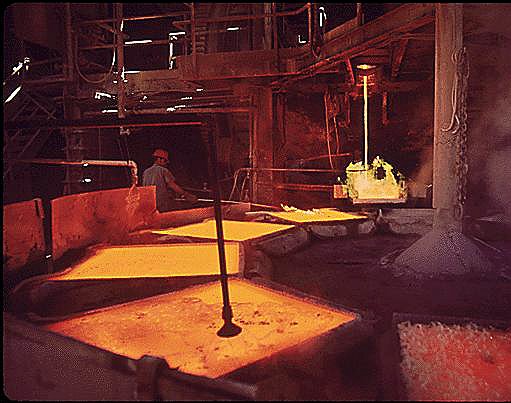 The EPA promulgated the Nonferrous Metals Manufacturing (NFMM) Effluent Guidelines and Standards (40 CFR Part 421Exit EPA’s website) initially in 1974-1976 and added subcategories and revised the regulations in 1980-1990 pursuant to Clean Water Act amendments and litigation. The regulations cover wastewater discharges from a wide range of metal manufacturing facilities. The NFMM Effluent Guidelines and Standards are incorporated into NPDES permits for direct dischargersdirect dischargersA point source that discharges pollutants to waters of the United States, such as streams, lakes, or oceans., and permits or other control mechanisms for indirect dischargersindirect dischargersA facility that discharges pollutants to a publicly owned treatment works (municipal sewage treatment plant). (see Pretreatment Program).
On this page:
* What is Nonferrous Metals Manufacturing?
* Facilities Covered
* Rulemaking History
* Additional Information
The EPA promulgated the Nonferrous Metals Manufacturing (NFMM) Effluent Guidelines and Standards (40 CFR Part 421Exit EPA’s website) initially in 1974-1976 and added subcategories and revised the regulations in 1980-1990 pursuant to Clean Water Act amendments and litigation. The regulations cover wastewater discharges from a wide range of metal manufacturing facilities. The NFMM Effluent Guidelines and Standards are incorporated into NPDES permits for direct dischargersdirect dischargersA point source that discharges pollutants to waters of the United States, such as streams, lakes, or oceans., and permits or other control mechanisms for indirect dischargersindirect dischargersA facility that discharges pollutants to a publicly owned treatment works (municipal sewage treatment plant). (see Pretreatment Program).
On this page:
* What is Nonferrous Metals Manufacturing?
* Facilities Covered
* Rulemaking History
* Additional Information
What is Nonferrous Metals Manufacturing?
Related Information * Stormwater Fact Sheet (Sector F: Primary Metals Facilities)
Primary metals manufacturers extract metals from ores and operate smelters, which heat ore mixtures to separate liquid metal and impurities. Secondary manufacturers process recycled or scrap metals. Extraction processes include chemical addition (e.g. limestone, coke, soda ash) and treatments (e.g. solvents). Some processes involve application of electrical current (e.g., aluminum, tin). The metals may be cast into various shapes (e.g., billets, ingots, bars) prior to shipment to customers, which fabricate final products. The wastewater streams generated by the industry vary according to the metal extraction processes employed, but generally derive from smelter furnace and filtration residues, rinsing of materials, spent solutions, equipment cooling and air pollution controls (wet scrubbers). These activities are included within the following NAICS codes: * 331313: Alumina Refining and Primary Aluminum Production * 331314: Secondary Smelting and Alloying of Aluminum * 331410: Nonferrous Metal (except Aluminum) Smelting and Refining * 331492: Secondary Smelting, Refining, and Alloying of Nonferrous Metal (except Copper and Aluminum)
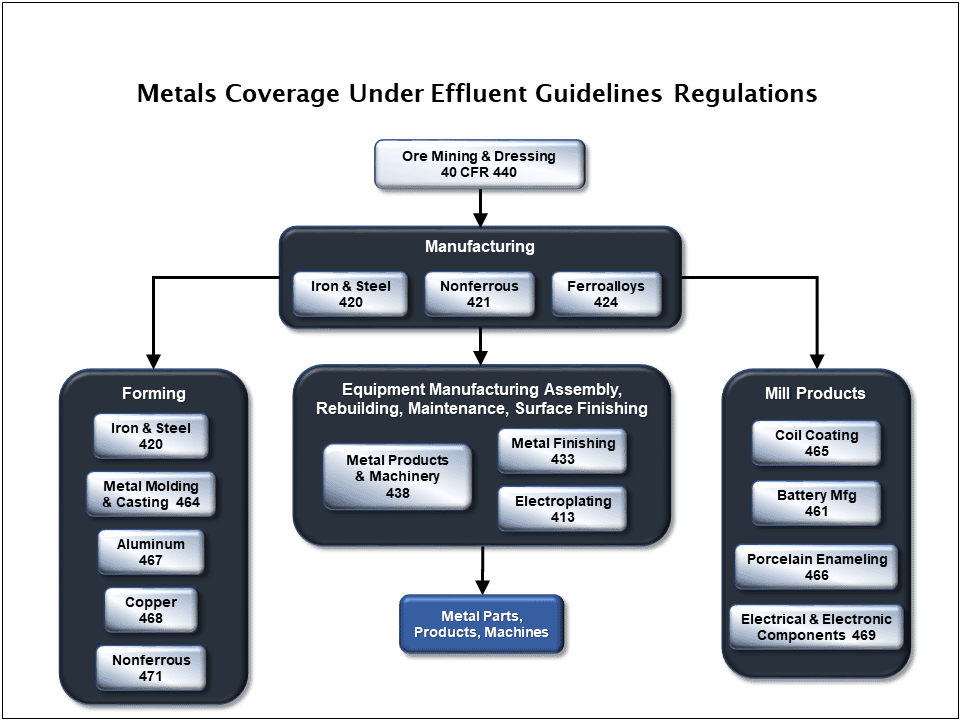 Metals coverage under Effluent Guidelines
- Click to enlarge
Note : The NAICS group listing is provided as a guide and does not define the coverage of the NFMM regulations. For precise definitions of coverage, see the applicability sections in 40 CFR Part 421Exit EPA’s website.
Note : Many post-extraction processes such as rolling, drawing, extruding and foil fabrication are covered by the Nonferrous Metals Forming and Metal Powders Category, (40 CFR Part 471Exit EPA’s website), the Aluminum Forming Category (40 CFR Part 467Exit EPA’s website), and the Copper Forming Category (40 CFR Part 468Exit EPA’s website).
Facilities Covered
The NFMM effluent guidelines apply to facilities in 31 subcategories: * Bauxite Refining (Subpart AExit EPA’s website) * Primary Aluminum Smelting (Subpart BExit EPA’s website) * Secondary Aluminum Smelting (Subpart CExit EPA’s website) * Primary Copper Smelting (Subpart DExit EPA’s website) * Primary Electrolytic Copper Refining (Subpart EExit EPA’s website) * Secondary Copper (Subpart FExit EPA’s website) * Primary Lead (Subpart GExit EPA’s website) * Primary Zinc (Subpart HExit EPA’s website) * Metallurgical Acid Plants (Subpart IExit EPA’s website) * Primary Tungsten (Subpart JExit EPA’s website) * Primary Columbium-Tantalum (Subpart KExit EPA’s website) * Secondary Silver (Subpart LExit EPA’s website) * Secondary Lead (Subpart MExit EPA’s website) * Primary Antimony (Subpart NExit EPA’s website) * Primary Beryllium (Subpart OExit EPA’s website) * Primary and Secondary Germanium and Gallium (Subpart PExit EPA’s website) * Secondary Indium (Subpart QExit EPA’s website) * Secondary Mercury (Subpart RExit EPA’s website) * Primary Molybdenum and Rhenium (Subpart SExit EPA’s website) * Secondary Molybdenum and Vanadium (Subpart TExit EPA’s website) * Primary Nickel and Cobalt (Subpart UExit EPA’s website) * Secondary Nickel (Subpart VExit EPA’s website) * Primary Precious Metals and Mercury (Subpart WExit EPA’s website) * Secondary Precious Metals (Subpart XExit EPA’s website) * Primary Rare Earth Metals (Subpart YExit EPA’s website) * Secondary Tantalum (Subpart ZExit EPA’s website) * Secondary Tin (Subpart AAExit EPA’s website) * Primary and Secondary Titanium (Subpart ABExit EPA’s website) * Secondary Tungsten and Cobalt (Subpart ACExit EPA’s website) * Secondary Uranium (Subpart ADExit EPA’s website) * Primary Zirconium and Hafnium (Subpart AEExit EPA’s website)
Rulemaking History
1990 Amendment
BAT revisions; Subparts I, O, S, T, X, AC
* Documents, including:
* Final rule (August 3, 1990)
* Development Document - Consolidation of all BAT Phase I & II revisions (May 1989)
Industry description, wastewater characterization, treatment technologies, regulatory compliance cost estimates and pollutant loadings for the final rule
* Proposed rule (April 28, 1989)
1988 Amendment
Revised Subpart J * Documents, including: * Final rule (January 21, 1988) * Proposed rule (January 22, 1987)
1987 Amendment
Revised Subparts B, C * Documents, including: * Final rule (July 7, 1987) * Proposed rule (May 20, 1986)
1985 Amendment
BAT Phase II (pursuant to 1977 CWA amendments); Subparts A, I, N-AE * Documents, including: * Final rule (September 20, 1985) * Proposed rule (June 27, 1984)
1984 Amendment
BAT Phase I (pursuant to 1977 CWA amendments); Subparts B-M * Documents, including: * Final rule (March 8, 1984) * Notice of data availability (November 21, 1983) * Proposed rule (February 17, 1983)
1980 Amendment
Revised the February 27, 1975 rule for Subparts D, E; added Subpart I * Final rule (July 2, 1980)
1976 Initial Rulemaking
PSES requirements added to Subparts C, F * Documents, including: * Interim final rule (PSES, Subparts C, F) (December 15, 1976) * Proposed rule (NSPS, PSNS, PSES; Subparts D, E, F, G, H) (February 27, 1975)
1975 Initial Rulemaking
Established BPT, BAT requirements: Subparts D, E, F, G, H * Documents, including: * Interim final rule (February 27, 1975) * Proposed rule (April 8, 1974)
1974 Initial Rulemaking
Established BPT, BAT, NSPS, PSNS requirements: Subparts A, B, C * Documents, including: * Final rule (April 8, 1974) * Proposed rule (November 30, 1973)
Additional Information
For additional information regarding the NFMM Effluent Guidelines, please contact Ahmar Siddiqui (siddiqui.ahmar@epa.gov) or 202-566-1044.
Effluent Guidelines
Open Sidenav Menu Close Sidenav Menu Contact Us About Effluent Guidelines Contact Us About Effluent Guidelines to ask a question, provide feedback, or report a problem. Last updated on May 8, 2026 Welcome! Please share your feedback on how we can make www.epa.gov work better for you. A red asterisk (*) indicates a required field.
Success
Thank you. Your feedback has been received.
Error
alert message Required Questions - page 1 of 2 question_55203_answer_01 How would you rate your experience on www.epa.gov today? *
0 Stars 1 Star 2 Stars 3 Stars 4 Stars 5 Stars Please explain the reason for your rating. * 400 characters allowed Would you like to take two more minutes to answer more questions to help us improve our services? Yes, keep going → No, only submit these responses Optional questions - page 2 of 2 How would you describe yourself? Business Government employee Scientist Student Other Enter other text Please tell us why you visited www.epa.gov today. 400 characters allowed Did you visit www.epa.gov to accomplish a specific task? If yes, please explain why you were able or unable to accomplish your task. 400 characters allowed How can we make www.epa.gov a more helpful website? 400 characters allowed Submit [NPDES]: National Pollutant Discharge Elimination System [NAICS]: North American Industrial Classification System [BAT]: Best Available Technology Economically Achievable [PSES]: Pretreatment Standards for Existing Sources [NSPS]: New Source Performance Standards [PSNS]: Pretreatment Standards for New Sources [BPT]: Best Practicable Technology Currently Available [*]: required