 Official websites use .gov
A .gov website belongs to an official government organization in the United States.
 Secure .gov websites use HTTPS
A lock (Lock A locked padlock) or https:// means you’ve safely connected to the .gov website. Share sensitive information only on official, secure websites.
Petroleum Refining Effluent Guidelines
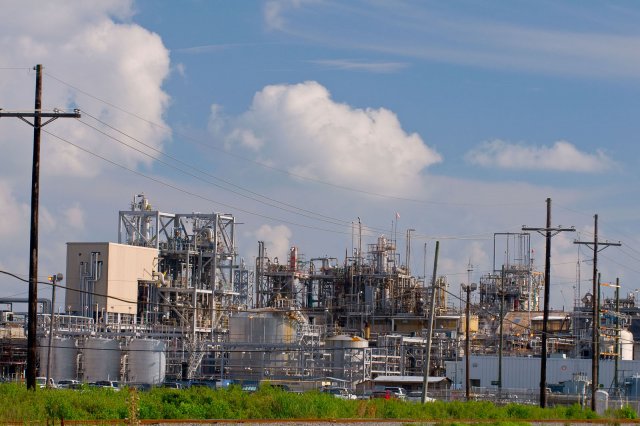 The EPA promulgated the Petroleum Refining Effluent Guidelines and Standards (40 CFR Part 419Exit EPA’s website) in 1974 and amended the regulations in 1975, 1977, 1982, and 1985. The regulations cover wastewater discharges at over 140 refineries across the country. The effluent guidelines and standards are incorporated into NPDES permits for direct dischargersdirect dischargersA point source that discharges pollutants to waters of the United States, such as streams, lakes, or oceans., and permits or other control mechanisms for indirect dischargersindirect dischargersA facility that discharges pollutants to a publicly owned treatment works (municipal sewage treatment plant). (see Pretreatment Program).
On this page: * What is Petroleum Refining? * Facilities Covered * Industry Studies * Implementation and Guidance Documents * Rulemaking History * Additional Information
What is Petroleum Refining?
Petroleum refineries process raw crude oil into three categories of products: * Fuel products —gasoline, distillate fuel oil, jet fuels, residual fuel oil, liquefied petroleum gases, refinery fuel, coke, and kerosene. * Nonfuel products —asphalt and road oil, lubricants, naphtha solvents, waxes, nonfuel coke, and miscellaneous products. * Petrochemicals and petrochemical feedstocks —naphtha, ethane, propane, butane, ethylene, propylene, butylene, and BTEX compounds (benzene, toluene, ethylbenzene, and xylene).
Process Summary
| Process category | Processes | Description |
| --- | --- | --- |
| Topping (Separating crude oil) |
* Desalting
* Atmospheric distillation
* Vacuum distillation
| Separates crude oil into hydrocarbon groups |
| Thermal and catalytic cracking |
* Thermal operations
* Delayed coking
* Fluid coking/ Flexicoking
* Visbreaking
* Catalytic cracking
* Catalytic hydrocracking
| Breaks large, heavy hydrocarbons from topping process into smaller hydrocarbons |
| Combining/rearranging hydrocarbons |
* Alkylation
* Polymerization
* Catalytic reforming
* Isomerization
| Processes hydrocarbons to form desired end products |
| Removing impurities | Catalytic hydrotreating | Removes impurities such as sulfur, nitrogen, and metals from products or waste gas streams |
| Specialty products blending and manufacturing |
* Lube oil
* Asphalt
| Blends product streams into final products or final processing into specialty products |
Major Wastewater Streams
| Wastewater | Description |
| --- | --- |
| Desalter water | Water produced from washing the raw crude prior to topping operations. |
| Sour water | Wastewater from steam stripping and fractionating operations that comes into contact with the crude being processed. |
| Other process water | Wastewater from product washing, catalyst regeneration, and dehydrogenation reactions. |
| Spent caustic | Formed in extraction of acidic compounds from product streams. |
| Tank bottoms | Bottom sediment and water settles to the bottom of tanks used to store raw crude. The bottoms are periodically removed. |
| Cooling tower | Once-through cooling tower water and cooling tower blowdown to prevent buildup of dissolved solids in closed-loop cooling systems. |
| Condensate blowdown | Blowdown from boilers and steam generators to control buildup of dissolved solids. |
| Source water treatment system | Source water must be treated prior to use in the refinery. Waste streams may include water from sludge dewatering if lime softening is used, ion exchange regeneration water, or reverse osmosis wastewater. |
| Stormwater | Process area and non-process area runoff from storm events. |
| Ballast water | Ballast water from product tankers. |
Petroleum refineries are categorized under NAICS code 32411. (Note: the NAICS group listing is provided as a guide and does not define the coverage of the Petroleum Refining regulations. For precise definitions of coverage, see the applicability sections in 40 CFR Part 419Exit EPA’s website.)
Facilities Covered
Covered wastestreams include process wastewater, ballast water, once-through cooling water, and contaminated and uncontaminated stormwater.
Petroleum Refining Subcategories
| Subcategory | Basic Refinery Operations Included |
| --- | --- |
| Topping (Subpart AExit EPA’s website) | Topping, catalytic reforming, asphalt production, or lube oil manufacturing processes, but excluding any facility with cracking or thermal operations |
| Cracking (Subpart BExit EPA’s website) | Topping and cracking |
| Petro-chemical (Subpart CExit EPA’s website) | Topping, cracking, and petrochemical operations |
| Lube (Subpart DExit EPA’s website) | Topping, cracking, and lube oil manufacturing processes |
| Integrated (Subpart EExit EPA’s website) | Topping, cracking, lube oil manufacturing processes, and petrochemical operations |
* “Petrochemical operations” is the production of second generation petrochemicals (i.e. alcohols, ketones, cumene, styrene, etc.) or first generation petrochemicals and isomerization products (i.e. BTEX, olefins, cyclohexane, etc.) when 15 percent or more of refinery production is as first generation petrochemicals & isomerization products.
Industry Studies
In 2019 the EPA concluded a study of wastewater discharges from petroleum refineries. As part of that study, the agency prepared a report compiling data on petroleum refining facilities, refinery wastewater characteristics, and available technologies for treating refinery wastewater. * Detailed Study of the Petroleum Refining Category (September 2019)
Previous Studies
- 2004 Study (August 2004)
- 1996 Study (April 1996)
Implementation and Guidance Documents
- Industrial Stormwater Fact Sheet:
Sector C - Chemical and Allied Products Manufacturing and Refining Facilities (December 2006) - Guide for the Application of Effluent Limitations Guidelines for the Petroleum Refining Category (June 1985)
Rulemaking History
1985 Amendment
Revised BAT, added stormwater limits (pursuant to litigation) * Documents, including: * Final rule (Correction; August 12, 1985) * Final rule (July 12, 1985) * Proposed rule (August 28, 1984)
1982 Amendment
Revised BAT, PSNS, PSES (pursuant to 1977 CWA amendments & litigation)
* Documents, including:
* Final rule (October 18, 1982)
* Development Document (October 1982)
Industry description, wastewater characterization, treatment technologies, regulatory compliance cost estimates and pollutant loadings for the final rule
* Proposed rule (December 21, 1979)
1977 Amendment
Established PSES * Documents, including: * Interim final rule (March 23, 1977) * Development Document Supplement for Pretreatment (March 1977) * Proposed rule (May 9, 1974)
1975 Amendment
Revised BPT: TSS and chromium-VI limits * Documents, including: * Final rule (May 20, 1975) * Proposed rule (October 17, 1974)
1974 Initial Rulemaking
Established BPT, BAT, NSPS, PSNS * Documents, including: * Final rule (May 9, 1974) * Development Document (April 1974) * Proposed rule (December 14, 1973)
Additional Information
For additional information about the Petroleum Refining Effluent Guidelines and Standards, please contact Samantha Lewis (lewis.samantha@epa.gov) or 202-566-1058.
Effluent Guidelines
Open Sidenav Menu Close Sidenav Menu Contact Us About Effluent Guidelines Contact Us About Effluent Guidelines to ask a question, provide feedback, or report a problem. Last updated on May 8, 2026 Welcome! Please share your feedback on how we can make www.epa.gov work better for you. A red asterisk (*) indicates a required field.
Success
Thank you. Your feedback has been received.
Error
alert message Required Questions - page 1 of 2 question_55203_answer_01 How would you rate your experience on www.epa.gov today? *
0 Stars 1 Star 2 Stars 3 Stars 4 Stars 5 Stars Please explain the reason for your rating. * 400 characters allowed Would you like to take two more minutes to answer more questions to help us improve our services? Yes, keep going → No, only submit these responses Optional questions - page 2 of 2 How would you describe yourself? Business Government employee Scientist Student Other Enter other text Please tell us why you visited www.epa.gov today. 400 characters allowed Did you visit www.epa.gov to accomplish a specific task? If yes, please explain why you were able or unable to accomplish your task. 400 characters allowed How can we make www.epa.gov a more helpful website? 400 characters allowed Submit [NPDES]: National Pollutant Discharge Elimination System [NAICS]: North American Industry Classification System []: required