 Official websites use .gov
A .gov website belongs to an official government organization in the United States.
 Secure .gov websites use HTTPS
A lock (Lock A locked padlock) or https:// means you’ve safely connected to the .gov website. Share sensitive information only on official, secure websites.
Soap and Detergent Manufacturing Effluent Guidelines
 The EPA promulgated the Soap and Detergent Manufacturing Effluent Guidelines and Standards (40 CFR Part 417Exit EPA’s website) in 1974-1975. Part 417 covers direct and indirect dischargers. The Effluent Guidelines and Standards are incorporated into NPDES permits for direct dischargersdirect dischargersA point source that discharges pollutants to waters of the United States, such as streams, lakes, or oceans. and permits or other control mechanisms for indirect dischargersindirect dischargersA facility that discharges pollutants to a publicly owned treatment works (municipal sewage treatment plant). (see Pretreatment Program).
On this page:
* What is the Soap and Detergent Manufacturing Industry?
* Facilities Covered
* BOD7 Effluent Limitation
* Rulemaking History
* Additional Information
The EPA promulgated the Soap and Detergent Manufacturing Effluent Guidelines and Standards (40 CFR Part 417Exit EPA’s website) in 1974-1975. Part 417 covers direct and indirect dischargers. The Effluent Guidelines and Standards are incorporated into NPDES permits for direct dischargersdirect dischargersA point source that discharges pollutants to waters of the United States, such as streams, lakes, or oceans. and permits or other control mechanisms for indirect dischargersindirect dischargersA facility that discharges pollutants to a publicly owned treatment works (municipal sewage treatment plant). (see Pretreatment Program).
On this page:
* What is the Soap and Detergent Manufacturing Industry?
* Facilities Covered
* BOD7 Effluent Limitation
* Rulemaking History
* Additional Information
What is the Soap and Detergent Manufacturing Industry?
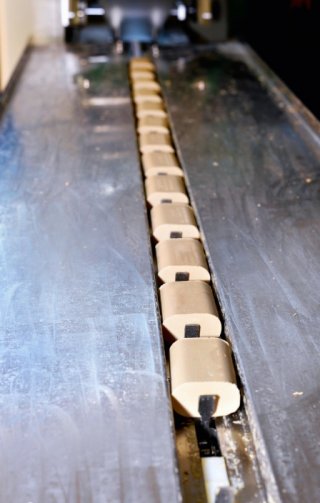
Industry facilities manufacture soap, synthetic organic detergents, inorganic alkaline detergents, or any combination. Crude and refined glycerine from vegetable and animal fats and oils are also included. Excluded from Part 417 coverage are establishments primarily engaged in manufacturing shampoos or shaving products and synthetic glycerine. Also excluded are specialty cleaners, polishing, and sanitation preparations. Wastewater is generated by steam pretreatment, soap boiling, equipment cleanouts, scrubber waters, scrap reclamation, condensers, still bottoms, and leaks and spills. These activities are included within NAICS code 325611, Soap and Other Detergent Manufacturing.
Note: The NAICS listing is provided as a guide and does not define the coverage of the Soap and Detergent Manufacturing category. For precise definitions of coverage, see the applicability sections in 40 CFR Part 417Exit EPA’s website.
Facilities Covered
The regulation is organized into 19 subcategories: * Soap Manufacturing by Batch Kettle (Subpart AExit EPA’s website) * Fatty Acid Manufacturing by Fat Splitting (Subpart BExit EPA’s website) * Soap Manufacturing by Fatty Acid Neutralization (Subpart CExit EPA’s website) * Glycerine Concentration (Subpart DExit EPA’s website) * Glycerine Distillation (Subpart EExit EPA’s website) * Manufacture of Soap Flakes and Powders (Subpart FExit EPA’s website) * Manufacture of Bar Soaps (Subpart GExit EPA’s website) * Manufacture of Liquid Soaps (Subpart HExit EPA’s website) * Oleum Sulfonation and Sulfation (Subpart IExit EPA’s website) * Air-SO3 Sulfation and Sulfonation (Subpart JExit EPA’s website) * SO3 Solvent and Vacuum Sulfonation (Subpart KExit EPA’s website) * Sulfamic Acid Sulfation (Subpart LExit EPA’s website) * Chlorosulfonic Acid Sulfation (Subpart MExit EPA’s website) * Neutralization of Sulfuric Acid Esters and Sulfonic Acids (Subpart NExit EPA’s website) * Manufacture of Spray Dried Detergents (Subpart OExit EPA’s website) * Manufacture of Liquid Detergents (Subpart PExit EPA’s website) * Manufacture of Detergents by Dry Blending (Subpart QExit EPA’s website) * Manufacture of Drum Dried Detergents (Subpart RExit EPA’s website) * Manufacture of Detergent Bars and Cakes (Subpart SExit EPA’s website)
BOD7 Effluent Limitation
Biochemical oxygen demand (BOD) is a measure of the oxygen-consuming properties of organic matter. Water with a high BOD indicates the presence of decomposing organic matter and subsequent high bacterial counts that degrade its quality. BOD 7 refers to the oxygen demand as determined by incubation at 20 ºC for a period of 7 days using an acclimated seed. The parameter BOD7 is used in subparts O, Q, and R. There is no approved analytical method for BOD7 in the EPA's test procedures regulation at 40 CFR Part 136Exit EPA’s website. There is a method available in Standard Methods, no. SM 5210C, which is called “Ultimate BOD Test” that can be run for 90 days. The example table in the procedure shows results across the time series from 0 to 90 days. The 7-day entry is highlighted. * Example: Results from Method 5210C (PDF)
Rulemaking History
1975 Amendments
- Documents, including:
Revised PSES:- Final Rule (June 30, 1975)
- Proposed Rule (February 20, 1975) Initial PSES:
- Final Rule (February 11, 1975)
- Proposed Rule (April 12, 1974)
1974 Initial Rulemaking
BPT, BAT, NSPS, PSNS
* Documents, including:
* Final Rule (April 12, 1974)
* Development Document (April 1974)
Industry description, wastewater characterization, treatment technologies, regulatory compliance cost estimates, and pollutant loadings for the final rule
* Proposed Rule (December 26, 1973)
Additional Information
For additional information regarding the Soap and Detergent Manufacturing Effluent Guidelines, please contact Paul Shriner (shriner.paul@epa.gov) or 202-566-1076.
Effluent Guidelines
Open Sidenav Menu Close Sidenav Menu Contact Us About Effluent Guidelines Contact Us About Effluent Guidelines to ask a question, provide feedback, or report a problem. Last updated on May 8, 2026 Welcome! Please share your feedback on how we can make www.epa.gov work better for you. A red asterisk (*) indicates a required field.
Success
Thank you. Your feedback has been received.
Error
alert message Required Questions - page 1 of 2 question_55203_answer_01 How would you rate your experience on www.epa.gov today? *
0 Stars 1 Star 2 Stars 3 Stars 4 Stars 5 Stars Please explain the reason for your rating. * 400 characters allowed Would you like to take two more minutes to answer more questions to help us improve our services? Yes, keep going → No, only submit these responses Optional questions - page 2 of 2 How would you describe yourself? Business Government employee Scientist Student Other Enter other text Please tell us why you visited www.epa.gov today. 400 characters allowed Did you visit www.epa.gov to accomplish a specific task? If yes, please explain why you were able or unable to accomplish your task. 400 characters allowed How can we make www.epa.gov a more helpful website? 400 characters allowed Submit [NPDES]: National Pollutant Discharge Elimination System [NAICS]: North American Industrial Classification System [PSES:]: Pretreatment Standards for Existing Sources [BPT]: Best Practicable Control Technology Currently Available [BAT]: Best Available Technology Economically Achievable [NSPS]: New Source Performance Standards [PSNS]: Pretreatment Standards for New Sources [*]: required