 Official websites use .gov
A .gov website belongs to an official government organization in the United States.
 Secure .gov websites use HTTPS
A lock (Lock A locked padlock) or https:// means you’ve safely connected to the .gov website. Share sensitive information only on official, secure websites.
Seafood Processing Effluent Guidelines
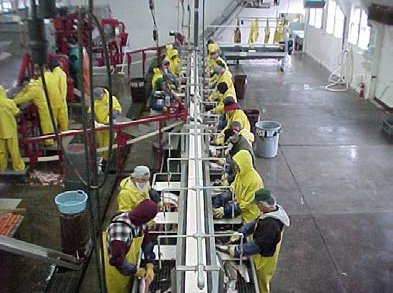 The EPA promulgated the Seafood Processing Effluent Guidelines and Standards (a.k.a. Canned and Preserved Seafood Category; 40 CFR Part 408Exit EPA’s website) in 1974 and 1975. The regulation covers wastewater discharges from facilities that preserve and can seafood. The Seafood Processing Effluent Guidelines and Standards are incorporated into NPDES permits.
On this page :
* What is Seafood Processing?
* Facilities Covered
* Alaskan Seafood Processing—1981 Proposed Rule
* Rulemaking History
* Additional Information
The EPA promulgated the Seafood Processing Effluent Guidelines and Standards (a.k.a. Canned and Preserved Seafood Category; 40 CFR Part 408Exit EPA’s website) in 1974 and 1975. The regulation covers wastewater discharges from facilities that preserve and can seafood. The Seafood Processing Effluent Guidelines and Standards are incorporated into NPDES permits.
On this page :
* What is Seafood Processing?
* Facilities Covered
* Alaskan Seafood Processing—1981 Proposed Rule
* Rulemaking History
* Additional Information
What is Seafood Processing?
Seafood preserving and canning facilities receive raw or frozen seafood from harvesting operations (e.g. fishing, trapping, netting). The facilities prepare the seafood products by butchering and cleaning. Prior to packaging, the seafood may be preserved typically by curing, cooking, or freezing. Wastewater may be generated from each stage in the process. These activities are included within NAICS codes 311711, Seafood Canning, and 311712, Fresh and Frozen Seafood Processing. (Note: the NAICS group listing is provided as a guide and does not define the coverage of the Seafood Processing regulations. For precise definitions of coverage, see the applicability sections in 40 CFR Part 408.)Exit EPA’s website
Facilities Covered
The Seafood Processing effluent guidelines apply to preserving and canning facilities in 33 subcategories: * Farm-Raised Catfish (Subpart AExit EPA’s website) * Conventional Blue Crab (Subpart BExit EPA’s website) * Mechanized Blue Crab (Subpart CExit EPA’s website) * Non-Remote Alaskan Crab Meat (Subpart DExit EPA’s website) * Remote Alaskan Crab Meat (Subpart EExit EPA’s website) * Non-Remote Alaskan Whole Crab & Crab Section (Subpart FExit EPA’s website) * Remote Alaskan Whole Crab & Crab Section (Subpart GExit EPA’s website) * Dungeness & Tanner Crab in the Contiguous States (Subpart HExit EPA’s website) * Non-Remote Alaskan Shrimp (Subpart IExit EPA’s website) * Remote Alaskan Shrimp (Subpart JExit EPA’s website) * Northern Shrimp in the Contiguous States (Subpart KExit EPA’s website) * Southern Non-Breaded Shrimp in the Contiguous States (Subpart LExit EPA’s website) * Breaded Shrimp in the Contiguous States (Subpart MExit EPA’s website) * Tuna (Subpart NExit EPA’s website) * Fish Meal (Subpart OExit EPA’s website) * Alaskan Hand-Butchered Salmon (Subpart PExit EPA’s website) * Alaskan Mechanized Salmon (Subpart QExit EPA’s website) * West Coast Hand-Butchered Salmon (Subpart RExit EPA’s website) * West Coast Mechanized Salmon (Subpart SExit EPA’s website) * Alaskan Bottom Fish (Subpart TExit EPA’s website) * Non-Alaskan Conventional Bottom Fish (Subpart UExit EPA’s website) * Non-Alaskan Mechanized Bottom Fish (Subpart VExit EPA’s website) * Hand-Shucked Clam (Subpart WExit EPA’s website) * Mechanized Clam (Subpart XExit EPA’s website) * Pacific Coast Hand-Shucked Oyster (Subpart YExit EPA’s website) * Atlantic & Gulf Coast Hand-Shucked Oyster (Subpart ZExit EPA’s website) * Steamed & Canned Oyster (Subpart AAExit EPA’s website) * Sardine (Subpart ABExit EPA’s website) * Alaskan Scallop (Subpart ACExit EPA’s website) * Non-Alaskan Scallop (Subpart ADExit EPA’s website) * Alaskan Herring Fillet (Subpart AEExit EPA’s website) * Non-Alaskan Herring Fillet (Subpart AFExit EPA’s website) * Abalone (Subpart AGExit EPA’s website)
Alaskan Seafood Processing—1981 Proposed Rule
On May 19, 1980, in response to a petition received by a portion of the industry, the EPA suspended the stricter effluent limits based on screening technology for Anchorage, Cordova, Juneau, Ketchikan, and Petersburg, and instead subjected processors in those areas to the limits for remote locations based upon grinding. On January 9, 1981, the EPA proposed revisions to subparts related to certain on-shore processors in Alaska, in response to petitions received from the industry. In 2010, the EPA sent questionnaires to seafood processing in Anchorage, Cordova, Juneau, Petersburg, Dutch Harbor, Ketchikan, and the Kenai Peninsula, and subsequently conducted supporting analyses of the data. In 2013, the EPA announced the availability of data and supporting analyses, provided preliminary indications of how the results may be reflected in amended effluent limitations, and solicited public comments. In July 2017, the EPA decided not to amend subparts of the Canned and Preserved Seafood Processing Category related to certain on-shore processors in Alaska. The Agency made this decision in light of the fact that all of the facilities subject to this rulemaking are located in the state of Alaska and the EPA concludes that the State of Alaska will establish additional water pollution controls at these facilities if and where the State determines such controls are appropriate and necessary. The EPA will continue to work with the state as it considers appropriate controls through its permitting actions. Under 40 CFR Part 408, the limitations for Anchorage, Cordova, Juneau, Ketchikan and Petersburg based upon grinding remain in effect. The notices related to these activities are available in the Rulemaking History section. Other related documents are available in the rulemaking docket at regulations.govExit EPA’s website. The docket number is EPA–HQ–OW–2013–0652.
Rulemaking History
2013 Notice of Data Availability
Alaskan seafood processing subcategories (Subparts D, E, F, G, I, J, P, Q, T, AC and AE) * Notice of Data AvailabilityExit EPA’s website (November 7, 2013)
1981 Proposed Rule
Alaskan seafood processing subcategories * (131.93 KB, June 10, 1981, 46 FR 30663) * (144.78 KB, March 23, 1981, 46 FR 18055) * (1.42 MB, January 9, 1981, 46 FR 2554) * (960.83 KB, August 7, 1980, 45 FR 52411) * (315.09 KB, May 19, 1980, 45 FR 32675)
1975 Rulemaking – Phase II
Established requirements for Subparts O-AG
* (4.63 MB, 12/1/1975, 40 FR 55770)
* (16.95 MB, September 1975, 440/1-75/041a)
Describes industry processes, pollutants generated, available control & treatment technologies, the technical basis for the final rule, and costs of the rule
* (4.01 MB, 1/30/1975, 40 FR 4582)
* (1.6 MB, 1/30/1975, 40 FR 4608)
Established PSES requirements for Subparts A-N * (1.2 MB, 2/11/1975, 40 FR 6432) * (489.59 KB, 6/26/1974, 39 FR 23154)
1974 Rulemaking - Phase I
Established BPT, BAT, NSPS and PSNS requirements for Subparts A-N
* (3.48 MB, 6/26/1974, 39 FR 23134)
* (14.06 MB, June 1974, 440/1-74-020a)
Describes industry processes, pollutants generated, available control & treatment technologies, the technical basis for the final rule, and costs of the rule
* (3.13 MB, 2/6/1974, 39 FR 4708)
Additional Information
For additional information regarding the Seafood Processing Effluent Guidelines, please contact Meghan Hessenauer (hessenauer.meghan@epa.gov) or 202-566-1040.
Effluent Guidelines
Open Sidenav Menu Close Sidenav Menu Contact Us About Effluent Guidelines Contact Us About Effluent Guidelines to ask a question, provide feedback, or report a problem. Last updated on March 17, 2026 Welcome! Please share your feedback on how we can make www.epa.gov work better for you. A red asterisk (*) indicates a required field.
Success
Thank you. Your feedback has been received.
Error
alert message Required Questions - page 1 of 2 question_55203_answer_01 How would you rate your experience on www.epa.gov today? *
0 Stars 1 Star 2 Stars 3 Stars 4 Stars 5 Stars Please explain the reason for your rating. * 400 characters allowed Would you like to take two more minutes to answer more questions to help us improve our services? Yes, keep going → No, only submit these responses Optional questions - page 2 of 2 How would you describe yourself? Business Government employee Scientist Student Other Enter other text Please tell us why you visited www.epa.gov today. 400 characters allowed Did you visit www.epa.gov to accomplish a specific task? If yes, please explain why you were able or unable to accomplish your task. 400 characters allowed How can we make www.epa.gov a more helpful website? 400 characters allowed Submit [NPDES]: National Pollutant Discharge Elimination System [NAICS]: North American Industrial Classification System [PSES]: Pretreatment Standards for Existing Sources [BPT]: Best Practicable Pollutant Control Technology Currently Available [BAT]: Best Available Technology Economically Achievable [NSPS]: New Source Performance Standards [PSNS]: Pretreatment Standards for New Sources [*]: required